
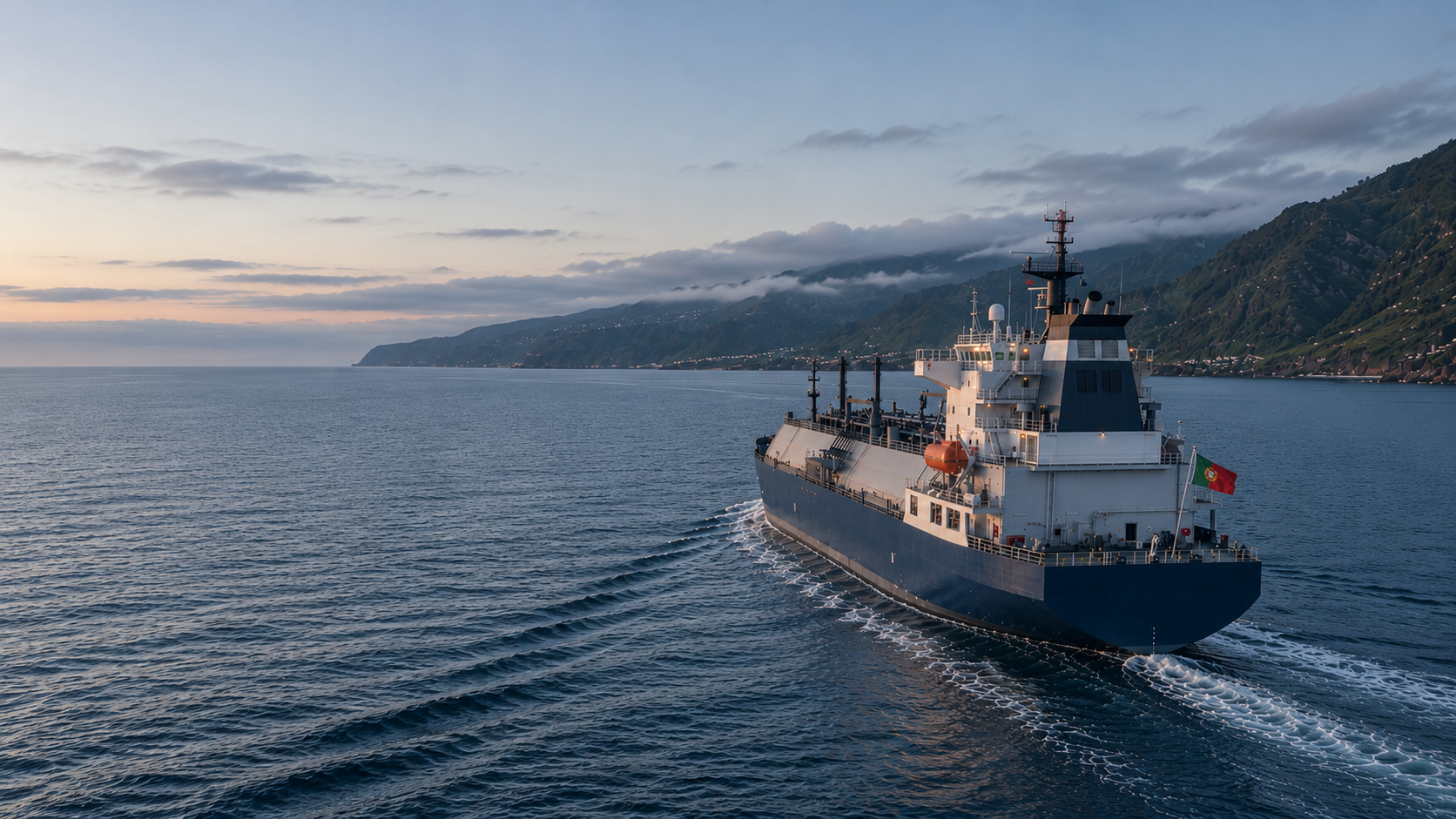

The Madeira International Shipping Register, known as MAR, comes up in almost every conversation about flagging in Europe. It is usually presented through its tax side alone, which is the easiest part to summarize and the one that explains the least. This article sets out what is worth knowing before considering it: what it is, what it asks for, what it gives and what work comes afterwards.
What the MAR register is
MAR is Portugal’s second ship register. It was created in 1989 within the Madeira International Business Centre to stop Portuguese vessels moving to flags of convenience and to attract foreign tonnage. Vessels on the register fly the Portuguese flag.
That makes it an EU register, with access to the European maritime transport market under the conditions set by EU legislation and all IMO and ILO conventions ratified by Portugal apply to it. It currently sits on the Paris MoU white list. That is the substantive difference with other international registers it gets compared to on price alone.
Among others, cargo vessels, passenger vessels, tugs, offshore units, pleasure crafts and commercial yachts may be registered under MAR.
Registration requirements
Who can register
There is no nationality requirement for the owner. A foreign company can own a MAR registered vessel through two routes: appointing a legal representative in Portugal with sufficient powers or setting up a company licensed in the Madeira International Business Centre and holding the vessel through it, in which case no representative is needed.
Temporary registration is also available, allowing a bareboat chartered vessel to be registered while ownership stays recorded abroad, and equally bareboat registration out to another flag.
Vessel age and prior survey
MAR sets no formal age limit. The Technical Committee decides case by case, looking at the age of the vessel and its inspection and detention record, and may require a survey before accepting the registration.
In practice, a vessel with recent port State control detentions will face a longer process and an almost certain survey. It is worth reviewing that record before filing the application.
Crew composition
At least 30 % of the safe manning must be Portuguese nationals, nationals of a European country or nationals of a Portuguese speaking country. The remaining 70 % carries no nationality restriction, and the requirement can be waived in duly justified cases.
Minimum manning is set by the Technical Committee based on a reasoned proposal from the owner, covering the characteristics of the vessel, its trade and its level of automation. It is not a fixed number decided in advance, and that is where crew management starts long before the first embarkation.
The benefits, in order of weight
An EU flag without the rigidity of a national register
This is the main point and the one most often forgotten when the conversation turns to tax. The vessel flies the flag of a Member State, with access to EU cabotage and the standing of a white list register, while the crew nationality rule is far more flexible than under a conventional national register.
Tax and social security
Wages earned by crew on MAR registered vessels are exempt from Portuguese income tax. On social security, non-Portuguese crew and their employers are generally not required to contribute to the Portuguese scheme provided an alternative public or private protection system is evidenced, covering sickness, occupational disease and parenthood. Portuguese crew or crew resident in Portugal contribute to the general scheme at a reduced rate of 2.7 %, of which 2 % is paid by the employer and 0.7 % by the crew member.
For the owning company, if it is licensed within the Madeira International Business Centre, the current regime applies a 5 % corporate tax rate on profits derived from eligible activities, within the limits and conditions approved by the European Union, until 31 December 2033.
Process and costs
The Madeira International Business Centre has its own commercial registry and notary, which shortens the procedure compared with other routes. Initial registration carries a fixed fee of 1,800 euros plus a variable part based on net tonnage, and the annual maintenance fee is 1,400 euros plus its own variable part. For passenger vessels, tugs and auxiliary craft these fees are 15 % higher on registration and 30 % higher on the annual fee. Companies licensed in the Madeira International Business Centre also pay a 1,000 euro licence fee and 1,800 euros a year in operating fees. The Centre provides an online calculator to estimate the amount for each vessel. Ship mortgages may be registered and are widely recognized by financing institutions.
What MAR does not solve
Worth saying with the same clarity:
- It reduces no technical obligation. International conventions apply in full and port State control inspections are the same.
- It does not simplify ISM and ISPS compliance. The safety management system, internal audits, the DPA and the CSO duties and responsibilities remain subject to the same international regulatory requirements.
- It is not automatic. The Technical Committee assesses each vessel, and a history of detentions carries significant weight.
- It does not replace tax advice. The tax position depends on where the company sits, where the crew are resident and which treaties apply.
How it is managed day to day
Registration is day one. What follows is continuous work, and it is what separates a comfortable flag from a source of incidents:
- Keeping to the approved manning. Every relief has to respect the percentage set by the Technical Committee. A last-minute change can leave the vessel outside its safe manning certificate.
- Tracking certificates and documentation. Manning certificates, licenses, surveys and the evidenced social cover of each non-Portuguese crew member.
- Preparing inspections. The detention record influences both the registration process and the vessel’s reputation thereafter.
- Coordinating with the company and the legal representative. Any change of ownership, mortgage or bareboat charter goes through the register.
This is the part that gets handed to a manager. Within a ship management contract these tasks sit across technical management and crew management, with regulatory compliance holding the two together. We covered that split in more detail in what a full ship management service covers.
About AMAZSA
We have been managing vessels from Bilbao since 1973 and we have our own office in Madeira, so MAR registration and its follow up are handled in house rather than through third parties. We offer technical management, crew management and ISM and ISPS compliance, separately or as a full management service, along with maritime services such as surveys and inspections.
If you are considering MAR for one or more vessels, get in touch and we will go through your case.